
Imagine training a powerful AI model without ever sharing your private data with anyone else. This revolutionary approach to machine learning is changing how companies and organizations build smarter systems while keeping sensitive information secure.
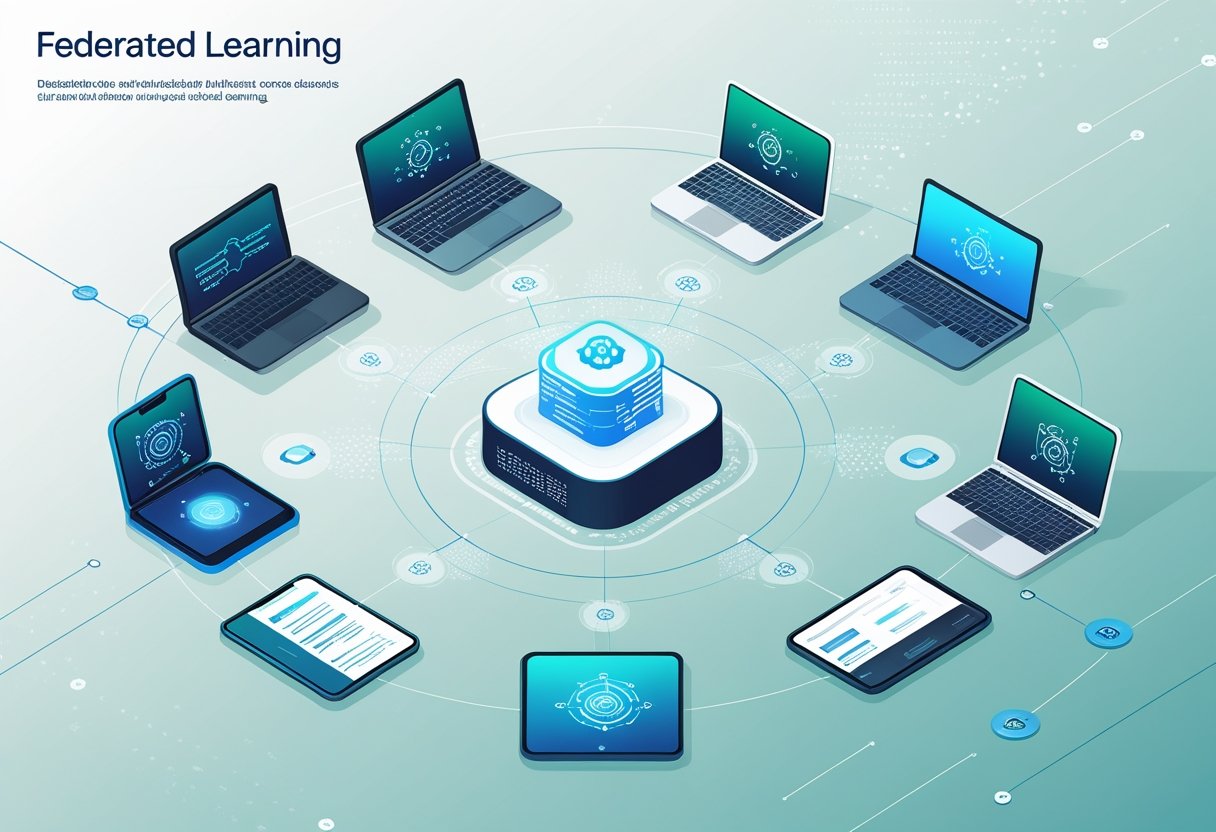
Federated learning allows multiple devices or organizations to train a shared machine learning model without exchanging their raw data. Instead of sending data to a central server, each participant trains the model locally on their own data. The working of a generic federated learning model involves model selection, distribution, training, and aggregation steps that happen across different locations.
This approach solves one of the biggest problems in AI development: accessing quality training data while protecting privacy. Healthcare systems can improve diagnoses without sharing patient records. Banks can detect fraud better without exposing customer information. Tech companies can make smartphones smarter without accessing personal photos or messages.
Key Takeaways
- Federated learning trains AI models across multiple devices without sharing raw data between participants
- The technology enables better privacy protection while still allowing organizations to benefit from collaborative machine learning
- Applications span healthcare, finance, and mobile technology where data privacy is critical for success
What Is Federated Learning?
Federated learning enables multiple devices to train AI models together without sharing raw data. This approach keeps sensitive information on local devices while building powerful machine learning systems through coordinated collaboration.
Definition and Core Principles
Federated learning is a collaboratively decentralized privacy-preserving technology that allows multiple clients to work together on machine learning problems. The system operates under central coordination while keeping training data distributed across devices.
The core principle revolves around local computing and model transmission. Each device performs calculations on its own data rather than sending raw information elsewhere. This fundamental shift protects user privacy while enabling collaborative AI development.
Two key ideas drive the entire process. First, devices train models locally using their own datasets. Second, only model updates travel between devices and servers, never the actual data.
This approach solves the challenge of data silos without compromising security. Organizations can benefit from shared learning while maintaining control over their sensitive information.
Comparison With Centralized Machine Learning
Traditional centralized machine learning requires all training data to exist on the same server. Companies must collect and store vast amounts of information in one location to build effective models.
Centralized systems face significant privacy risks during data collection and processing. Personal information travels across networks and gets stored on remote servers beyond user control.
Federated systems eliminate these risks by reversing the process. Instead of moving data to algorithms, the algorithms travel to the data. Each device trains locally and shares only encrypted model parameters.
| Aspect | Centralized ML | Federated Learning |
|---|---|---|
| Data Location | Single server | Distributed devices |
| Privacy Risk | High | Low |
| Data Transfer | Required | Not required |
| Storage Costs | High | Distributed |
The federated approach particularly benefits mobile applications where users want personalized models without sacrificing privacy.
Main Components: Clients, Server, and Aggregator
The federated learning architecture consists of three essential components working together. Clients represent individual devices or organizations that possess local datasets and computing capabilities.
Each client trains machine learning models using only their local data. They never share raw information with other participants in the network.
The central server acts as the coordination hub for the entire federated system. It manages communication between clients and orchestrates the training process across all participants.
Aggregators combine model updates from multiple clients into a single global model. This component ensures that insights from all participants contribute to the final machine learning system.
The process follows a cyclical pattern. Clients receive the current global model, train it locally, then send updates back to the aggregator. The server distributes the improved model to all participants for the next training round.
This architecture enables thousands of devices to collaborate on AI development while maintaining complete data sovereignty.
How Federated Learning Works
Federated learning operates through a coordinated cycle where multiple devices train models locally and share updates with a central server. The process handles diverse data distributions while minimizing communication overhead.
Model Initialization and Global Model Updates
The federated learning process begins when a central server creates an initial global model. This model contains the basic structure and starting weights for the machine learning algorithm.
The server sends this initial model to participating devices or clients. Each device receives an identical copy of the global model parameters.
After local training occurs on each device, the server collects model updates from participating clients. These updates contain changes to the model weights rather than raw data.
The server then creates a new global model by combining all received updates. This updated global model reflects learning from data across all participating devices.
Key aspects of model updates:
- Only model parameters are shared, not actual data
- Updates are typically much smaller than full datasets
- The global model improves with each training round
Local Model Training on Devices
Each participating device performs local training using its own data. The device downloads the current global model and trains it on locally stored information.
Local training typically involves several iterations or epochs. The device adjusts model parameters based on patterns in its local dataset.
Devices calculate gradients and update model weights during this process. The training uses standard machine learning algorithms like neural networks or decision trees.
Once local training completes, devices prepare model updates for transmission. These updates represent the changes made during local training rather than the complete model.
Benefits of local training:
- Data never leaves the device
- Training can happen offline
- Each device contributes unique learning patterns
Model Aggregation and Communication Cycle
Model aggregation combines updates from multiple devices into a single improved global model. The most common method is federated averaging, which weights updates based on the amount of local training data.
The communication cycle follows a specific pattern. First, the server distributes the current global model to selected devices.
Next, devices perform local training and send back their model updates. The server collects these updates and performs aggregation to create an improved global model.
This cycle repeats multiple times until the model reaches satisfactory performance. Each round of communication and aggregation improves the global model’s accuracy.
Communication efficiency measures:
- Reduced data transfer through compressed updates
- Selective participation of devices per round
- Lower communication costs compared to centralized approaches
Handling Non-IID Data and Data Distribution
Real-world federated learning faces challenges with non-IID data, where each device has different types or distributions of information. This creates uneven learning across the network.
Non-IID data occurs when devices have varying data characteristics. For example, mobile phones in different regions may have different user behavior patterns.
Several techniques help address data distribution problems. These include adjusting aggregation weights, using personalized models, and applying regularization methods.
Advanced federated learning systems monitor data distribution across devices. They adapt training strategies to ensure fair representation from all participants.
Strategies for non-IID data:
- Weighted aggregation based on data quality
- Clustering devices with similar data patterns
- Personalized model layers for local adaptation
- Data sharing techniques that preserve privacy
Types of Federated Learning
Federated learning systems operate through different approaches based on how data is distributed and shared among participants. The main types include horizontal systems where participants share similar data features, vertical systems where different organizations contribute unique data attributes, and transfer learning approaches that adapt models across different domains.
Horizontal Federated Learning
Horizontal federated learning works when different organizations have datasets with the same features but different samples. Banks using this approach might each have customer credit scores, income data, and loan histories for different groups of people.
Each participant trains a local model using their own data. The system then combines these local models to create a global model without sharing raw data.
This type works best when organizations collect similar information but serve different customer bases. Cross-device scenarios like smartphones training keyboard prediction models use horizontal federated learning.
The main challenge involves handling data that varies in quality and quantity across participants. Some organizations might have thousands of samples while others have only hundreds.
Privacy protection happens because raw customer data never leaves each organization’s servers. Only model updates get shared during the training process.
Vertical Federated Learning
Vertical federated learning happens when organizations have different types of data about the same group of people or items. A bank and a retail store might both serve the same customers but collect different information about them.
The bank has financial data like account balances and payment history. The retail store has purchase patterns and product preferences for the same customers.
Cross-silo federated learning often uses vertical approaches when large organizations want to combine their unique datasets. The system matches common identifiers like customer IDs while keeping sensitive data private.
Training requires more complex coordination than horizontal approaches. Organizations must align their data samples and securely compute joint models without revealing their private features.
This approach creates more powerful models because it combines diverse data types that no single organization could access alone.
Federated Transfer Learning
Federated transfer learning applies when participants have different types of data and different sample populations. This approach adapts knowledge from one domain to help solve problems in another domain.
A hospital with medical imaging data might help improve a research center’s drug discovery models. The domains are different but the underlying machine learning principles can transfer between them.
Transfer learning techniques work by identifying common patterns that apply across different but related problems. The system transfers learned features rather than raw data or complete models.
This type proves useful when organizations have limited data in their target domain. They can benefit from knowledge gained in data-rich domains through federated collaboration.
The challenge involves determining which knowledge transfers well between different domains and organizations. Not all learned patterns apply across different contexts or data types.
Centralized vs. Decentralized Approaches
Centralized federated learning uses a central server to coordinate model training and updates. Participants send their model updates to this server, which combines them and sends back the improved global model.
Distributed machine learning systems often use centralized coordination because it simplifies the training process. The central server handles all communication and ensures participants stay synchronized.
Decentralized approaches eliminate the central server entirely. Participants communicate directly with each other to share model updates and coordinate training.
Decentralized machine learning provides better privacy protection because no single entity controls the entire system. It also reduces the risk of system failure if one server goes down.
The trade-off involves complexity versus control. Centralized systems are easier to manage but create single points of failure and potential privacy concerns.
Privacy, Security, and Legal Compliance

Federated learning addresses critical data protection challenges through differential privacy techniques and secure aggregation methods. Organizations must navigate complex regulatory frameworks like GDPR and HIPAA while implementing privacy-preserving technologies to ensure legal compliance.
Data Privacy and Data Protection Regulations
Data privacy regulations significantly impact how organizations implement federated learning systems. GDPR requires explicit consent for data processing and grants individuals rights to data portability and erasure.
HIPAA mandates strict protections for healthcare data in federated medical research. Organizations must ensure patient information remains secure during model training across multiple institutions.
Key regulatory requirements include:
- Data minimization: Only necessary data participates in training
- Purpose limitation: Models serve specified research objectives
- Accountability: Organizations document privacy protection measures
- Transparency: Clear communication about data usage practices
Privacy regulations for federated learning systems require careful consideration of cross-border data flows. Different jurisdictions impose varying compliance obligations on distributed machine learning projects.
Privacy concerns arise when gradient updates potentially leak sensitive information about training data. Organizations must implement technical safeguards to prevent unauthorized data reconstruction from model parameters.
Privacy-Preserving Techniques
Differential privacy adds mathematical noise to gradient updates, preventing attackers from identifying individual data points. This technique provides quantifiable privacy guarantees while maintaining model accuracy.
The privacy budget determines how much noise gets added to computations. Smaller budgets provide stronger privacy protection but may reduce model performance.
Homomorphic encryption enables computations on encrypted data without decryption. Participants can train models on sensitive information while keeping raw data completely private.
Key privacy-preserving methods:
- Gradient perturbation through controlled noise injection
- Local differential privacy at individual device level
- Secure aggregation protocols for parameter updates
- Privacy measurement techniques for quantifying protection levels
Blockchain technology can enhance federated learning privacy through decentralized model updates. Smart contracts automate privacy-preserving computations without trusted third parties.
Privacy-preserving AI techniques must balance protection strength with computational efficiency. Organizations select methods based on their specific threat models and performance requirements.
Secure Aggregation and Multi-Party Computation
Secure aggregation protocols allow multiple parties to combine model updates without revealing individual contributions. Each participant’s data remains private during the collaborative training process.
Multi-party computation enables joint model training across organizations without sharing raw datasets. Cryptographic protocols ensure no single party can access others’ sensitive information.
Secure aggregation components:
| Technique | Purpose | Security Level |
|---|---|---|
| Secret sharing | Distribute model parameters | High |
| Masking protocols | Hide individual updates | Medium |
| Threshold cryptography | Require minimum participants | High |
Trusted execution environments provide hardware-based security for federated computations. These secure enclaves protect model updates from both external attackers and malicious participants.
Trustworthy federated learning systems implement multiple security layers to prevent various attack vectors. Organizations must consider both technical and operational security measures.
Secure multi-party computation protocols scale to hundreds of participants while maintaining privacy guarantees. Recent advances reduce computational overhead for practical deployment scenarios.
Legal Considerations and Regulatory Compliance
Legal compliance in federated learning requires understanding jurisdiction-specific requirements for distributed data processing. Organizations must establish clear data governance frameworks before implementation.
Medical research applications face additional regulatory scrutiny under healthcare privacy laws. Institutional review boards evaluate federated learning protocols for ethical compliance.
Compliance requirements include:
- Data processing agreements between participating organizations
- Privacy impact assessments for federated systems
- Audit trails for model training and deployment activities
- Incident response procedures for potential data breaches
Cross-border federated learning projects must navigate international data transfer restrictions. Organizations need adequate safeguards when model updates cross jurisdictional boundaries.
Legal frameworks continue evolving as AI data privacy regulations develop worldwide. Organizations should monitor regulatory changes affecting their federated learning implementations.
Contractual arrangements must specify liability allocation for privacy violations across federated participants. Clear agreements prevent disputes over regulatory compliance responsibilities.
Federated Learning Frameworks and Tools

Several open-source frameworks provide ready-to-use implementations of federated learning algorithms, while major AI platforms now offer built-in federated capabilities. These tools implement sophisticated optimization methods like FedAvg to coordinate model training across distributed devices.
Popular Open-Source Frameworks
Multiple open-source federated learning frameworks exist to help developers implement FL systems. TensorFlow Federated (TFF) stands as Google’s official framework for federated learning research and development.
TFF integrates directly with TensorFlow and Keras models. It provides simulation environments for testing federated algorithms before deployment.
PySyft offers another popular choice for privacy-preserving machine learning. This framework supports PyTorch and TensorFlow backends.
OpenFL serves as Intel’s open federated learning library for collaborative model training. It focuses on horizontal federated learning scenarios where participants share similar data structures.
FATE (Federated AI Technology Enabler) provides enterprise-grade federated learning capabilities. It includes security features like homomorphic encryption and differential privacy.
Flower represents a newer framework that emphasizes simplicity and scalability. It supports various machine learning libraries including PyTorch, TensorFlow, and scikit-learn.
Integration With Existing AI Platforms
Major AI platforms now include federated learning capabilities within their ecosystems. TensorFlow Federated integrates seamlessly with existing TensorFlow workflows and Keras model architectures.
PyTorch users can leverage PySyft for federated training without changing their model code significantly. The framework wraps existing PyTorch operations with federated learning protocols.
Cloud platforms like Google Cloud AI and AWS offer managed federated learning services. These services handle infrastructure complexity while developers focus on model development.
Many frameworks provide APIs that connect to popular machine learning libraries. This compatibility reduces the learning curve for teams already using TensorFlow, PyTorch, or Keras.
Mobile development frameworks also support federated learning integration. TensorFlow Lite and Core ML can deploy federated models on edge devices.
Optimization Algorithms and Model Averaging
Federated Averaging (FedAvg) serves as the foundational optimization algorithm for most federated learning systems. It combines local model updates from multiple clients into a global model.
The FedAvg algorithm works by averaging model weights based on the amount of training data each client contributed. Clients with more data have greater influence on the final model.
Advanced optimization methods extend beyond basic averaging. FedProx adds a regularization term to handle data heterogeneity across clients.
Adaptive optimization algorithms like FedAdam and FedYogi apply momentum-based updates to improve convergence. These methods work better when client data distributions vary significantly.
Compression techniques reduce communication costs during model aggregation. Methods like gradient quantization and sparsification minimize bandwidth requirements while maintaining model accuracy.
Applications and Use Cases
Federated learning transforms industries by enabling AI model training across distributed data without compromising privacy. Federated learning is revolutionizing industries by enabling AI model training across distributed data while safeguarding privacy. In healthcare, organizations can share valuable medical insights while protecting patient records. Financial institutions collaborate to detect fraud, enhancing security without compromising sensitive information. Additionally, IoT devices can learn from collective experiences, all without exposing user data.
Healthcare and Medical Data Analysis
Healthcare represents one of the most promising areas for federated learning applications. Hospitals can collaborate to train AI models without sharing sensitive patient data across institutional boundaries.
Medical researchers use this approach to develop better diagnostic tools. Multiple hospitals contribute to training neural networks for cancer detection while keeping patient records secure within each facility.
Key healthcare applications include:
- Disease prediction models across hospital networks
- Drug discovery research with pharmaceutical companies
- Medical imaging analysis for radiology departments
- Personalized treatment recommendations
The technology allows rare disease research where no single institution has enough cases. Pediatric hospitals can combine their limited data to create robust AI models for childhood conditions.
Privacy regulations like HIPAA make traditional data sharing difficult. Federated learning solves this by keeping patient information local while still enabling collaborative research.
Finance, Fraud Detection, and Privacy-Sensitive Industries
Financial institutions leverage federated learning for fraud detection without sharing customer transaction data. Banks collaborate to identify suspicious patterns while maintaining strict privacy controls.
Credit card companies train AI models across their networks to spot fraudulent transactions. Each company contributes to the learning process without revealing individual customer behaviors or financial details.
Common financial use cases:
- Real-time fraud detection systems
- Credit risk assessment models
- Anti-money laundering detection
- Customer behavior analysis
Insurance companies use federated learning to assess risk profiles. They can build better actuarial models by learning from industry-wide data without exposing policyholder information.
Regulatory compliance becomes easier since sensitive data never leaves each organization’s secure environment. This approach meets strict financial privacy requirements while improving AI model accuracy.
IoT, Smart Devices, and Edge Computing
IoT devices generate massive amounts of data that federated learning can process locally. Smart home devices, wearables, and industrial sensors learn from collective experiences without transmitting raw data to central servers.
Smartphones use on-device ai to improve features like voice recognition and predictive text. The device learns from user behavior while contributing to global model improvements without sharing personal information.
Smart device applications include:
- Voice assistant improvement across device fleets
- Predictive maintenance for industrial equipment
- Energy optimization in smart buildings
- Personal health monitoring through wearables
Edge computing pairs naturally with federated learning. Devices process data locally and only share model updates, reducing bandwidth requirements and improving response times.
Smart cities deploy federated learning across traffic sensors and surveillance cameras. The system optimizes traffic flow and enhances security while protecting citizen privacy from potential IoT threats.
Autonomous Vehicles and Real-Time AI
Autonomous vehicles represent a critical application where federated learning enables safe AI development. Cars learn from collective driving experiences without sharing sensitive location data or personal travel patterns.
Vehicle fleets contribute to shared knowledge about road conditions, weather responses, and driving scenarios. Each car benefits from the experiences of thousands of other vehicles while maintaining passenger privacy.
Automotive applications:
- Hazard detection and avoidance systems
- Traffic pattern recognition
- Weather response optimization
- Parking assistance improvements
Real-time ai requirements make federated learning essential for autonomous systems. Vehicles need instant responses that centralized processing cannot provide due to latency constraints.
Manufacturing companies use similar approaches for robotic systems. Factory robots learn from experiences across multiple production facilities without sharing proprietary manufacturing data.
Deep learning models for autonomous navigation improve continuously through federated training. This collaborative approach accelerates AI development while addressing safety concerns about data sharing in transportation networks.
Benefits and Challenges of Federated Learning
Federated learning offers significant advantages in privacy preservation and reduced communication overhead. However, it faces notable challenges including communication costs and coordination complexity across distributed systems.
Advantages Over Traditional Methods
Privacy Preservation stands as federated learning’s most compelling benefit. Data never leaves individual devices or organizations. This approach eliminates the need to centralize sensitive information in a single location.
Traditional machine learning requires collecting all data in one place. This creates privacy risks and regulatory compliance issues. Federated learning keeps data privacy intact by training models locally.
Reduced Data Transfer makes federated learning highly efficient. Only model updates move between participants, not raw data. This dramatically cuts bandwidth requirements compared to centralized approaches.
Decentralized Data access enables collaboration across organizations. Companies can work together without sharing proprietary information. Healthcare providers can improve medical models while keeping patient records secure.
The approach works well for edge computing scenarios. Mobile devices can contribute to model training without uploading personal data. This creates better models while respecting user privacy.
Current Limitations and Open Problems
Communication Costs represent a major challenge in federated systems. Frequent model updates between participants create network overhead. Research shows that reducing communication remains an active area of development.
Model Training complexity increases significantly in distributed environments. Coordinating updates across hundreds or thousands of participants requires sophisticated algorithms. Non-uniform data distribution across participants can hurt model performance.
System Heterogeneity creates technical hurdles. Participants may have different computing power, network speeds, or availability schedules. This makes it difficult to maintain consistent training progress.
Security Vulnerabilities emerge from the distributed nature. Malicious participants could potentially attack the shared model. Current federated learning research continues addressing these security concerns.
Debugging and monitoring distributed training proves more complex than centralized approaches. Organizations need new tools and processes to manage federated learning deployments effectively.
Frequently Asked Questions
Federated learning presents unique challenges around privacy protection, algorithm design, and real-world implementation. Organizations across healthcare, finance, and technology sectors use different architectural approaches to train models while keeping sensitive data distributed.
What are some practical applications of federated learning in various industries?
Healthcare organizations use federated learning to train diagnostic models across hospitals without sharing patient records. Medical researchers can analyze medical imaging through federated learning while maintaining patient privacy.
Financial institutions apply federated learning for fraud detection systems. Banks collaborate to identify suspicious patterns without exposing customer transaction data to competitors.
Smartphone companies use federated learning to improve keyboard prediction and voice recognition. The training happens on individual devices, so personal messages and voice data never leave the phone.
Autonomous vehicle manufacturers employ federated learning to enhance safety systems. Different car brands can share driving insights without revealing proprietary sensor data or route information.
How does federated learning enhance privacy and security compared to traditional machine learning?
Traditional machine learning requires collecting all training data in one central location. This creates security risks when sensitive information travels across networks and gets stored in centralized databases.
Federated learning keeps raw data on local devices or servers. Only model updates move between participants, which contain mathematical parameters rather than actual data records.
Privacy-preserving techniques in federated learning include differential privacy and homomorphic encryption. These methods add mathematical noise or encrypt model updates to prevent data reconstruction.
The distributed approach reduces single points of failure. If one server gets compromised, attackers cannot access the complete dataset from all participants.
Can you describe the main types of federated learning architectures?
Horizontal federated learning works when participants have datasets with the same features but different samples. Multiple hospitals with similar patient records but different patients use this approach.
Vertical federated learning applies when participants have different features for the same samples. A bank and insurance company might both have data about the same customers but different types of information.
Federated transfer learning helps when participants have different features and different samples. Organizations can still collaborate by transferring knowledge from related domains or tasks.
Cross-silo federated learning connects organizations like hospitals or banks. These participants have reliable internet connections and participate in planned training sessions.
Cross-device federated learning involves millions of smartphones or IoT devices. The system must handle intermittent connections and devices that frequently go offline.
What are the key differences between federated learning and distributed learning?
Distributed learning splits large datasets across multiple machines for faster processing. All machines typically belong to the same organization and share the same network infrastructure.
Federated learning connects independent organizations or devices that own their data. Participants may have different hardware, network conditions, and data privacy requirements.
Communication costs matter more in federated learning because participants connect over slower internet connections. Distributed learning often uses high-speed connections within data centers.
Data distribution varies significantly in federated learning systems. Some participants might have much more data or different types of data compared to others.
Trust relationships differ between the two approaches. Distributed learning assumes all participants trust each other, while federated learning must work with competing organizations.
How are federated learning algorithms uniquely structured to handle data across decentralized networks?
Federated learning algorithms focus on communication efficiency because sending data over networks costs time and money. They minimize the number of communication rounds needed for training.
Local training happens on each participant’s device or server. The algorithm performs multiple training steps locally before sharing updates with other participants.
Aggregation methods combine model updates from all participants. The most common approach averages the updates, but more sophisticated methods account for different data sizes and quality.
Asynchronous training allows participants to contribute updates at different times. This helps when devices have varying computational power or network availability.
Adaptive algorithms adjust to handle non-identical data distributions across participants. They prevent the model from becoming biased toward participants with more data.
What are the challenges and limitations associated with implementing federated learning in real-world scenarios?
Communication overhead creates significant delays in federated learning systems. Sending model updates across networks takes much longer than accessing data from local storage.
Non-identical data distributions cause model performance problems. When participants have very different data, the global model may work poorly for some participants.
Device reliability affects training consistency. Mobile devices frequently disconnect, run out of battery, or have limited computational resources for training.
System heterogeneity complicates implementation across different hardware and software platforms. Participants may use different operating systems, programming languages, or machine learning frameworks.
Regulatory compliance adds legal complexity to federated learning projects. Different countries have varying data protection laws that affect how organizations can participate in collaborative training.